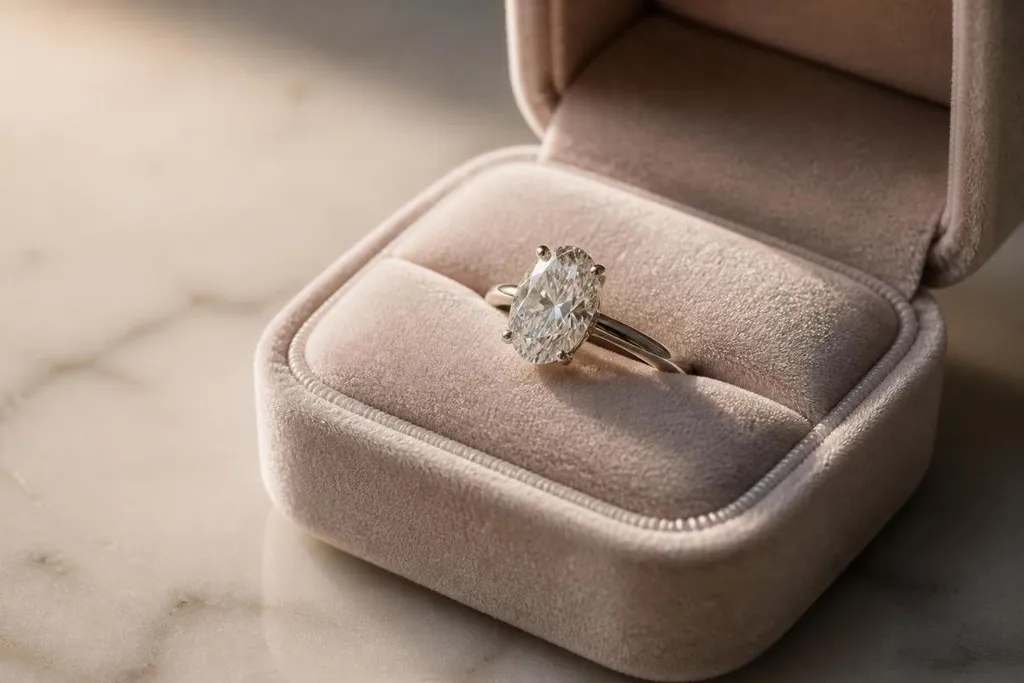
A solitaire engagement ring leaves little room for unnecessary detail. The centre stone, setting and band have to carry the entire design, which is precisely why the combination of an oval lab-grown diamond and platinum works so convincingly. The diamond provides graceful length and brilliance, while platinum creates a naturally white, understated framework with the strength expected from jewellery designed for decades of wear.
For someone considering this pairing, the option to order the platinum Isabella ring from Lily Arkwright shows how an oval lab diamond and 950 platinum can create a clean, balanced engagement ring. Rather than relying on a halo or diamond-set shoulders for impact, the design allows the proportions of the oval centre stone to provide its character. That restraint makes details such as diamond shape, band width and setting construction particularly important.
Why Oval Diamonds Work So Well as Solitaires
An oval diamond offers a useful balance between traditional softness and contemporary proportion. Its curved outline feels familiar, yet the elongated shape gives it a distinctly different presence from a round brilliant.
That length can create an elegant line along the finger and often makes the stone appear visually substantial from above. However, carat weight alone does not determine this effect. Two oval diamonds of identical weight can have noticeably different dimensions depending on how their proportions are distributed.
Length-to-width ratio is therefore worth considering. A broader oval produces a fuller silhouette, while a more elongated stone has a slender, graceful appearance. Neither should be selected purely because it falls within a particular numerical range; the right proportion is the one that looks balanced on the wearer's hand.
A solitaire setting makes these differences especially visible because there are no surrounding stones changing the outline. The oval itself becomes the design.
What 950 Platinum Contributes
Platinum is particularly well suited to a ring intended to look clean and restrained.
Its naturally white colour provides a neutral setting around a bright lab-grown diamond. Rather than introducing a warm contrast, as yellow or rose gold would, platinum visually supports the stone and allows its outline and light performance to take priority.
There is also a practical reason for choosing it. Platinum is dense and durable, qualities that make it valuable for engagement rings designed for frequent wear. In a solitaire, the centre setting performs an important structural role, so the properties of the metal are more than an aesthetic consideration.
Durability does not mean platinum remains completely unmarked. Everyday contact gradually produces a characteristic patina as the surface develops fine signs of wear. Some people appreciate this softer finish, while professional polishing can restore a brighter appearance if preferred.
Regular inspections remain sensible, particularly around the claws securing the centre diamond.
Choosing Size Without Losing Proportion
A larger oval diamond does more than increase the numerical carat weight; it can alter the relationship between the stone, band and hand.
Someone may prefer a 2-carat oval over a 1-carat diamond because the larger dimensions give the solitaire greater presence without requiring additional decorative stones. For a wearer who wants the engagement ring to stand confidently on its own, that can be a compelling reason to increase size.
Another person might choose a smaller diamond because they favour restrained jewellery or intend to pair the engagement ring with a more prominent wedding or eternity band.
Band proportions matter at the same time. A fine platinum band can emphasise the scale of the centre stone, while a slightly more substantial band may visually anchor a larger oval.
The aim should be harmony rather than maximum size. Viewed from above and from the side, the diamond should look deliberately matched to the setting rather than simply placed on top of it.
Think About Everyday Wear and Wedding-Band Pairing
The simplicity of a platinum solitaire makes it highly adaptable, but practical details still deserve consideration.
Setting height influences how prominent the diamond feels and how readily the ring interacts with clothing and daily activities. It can also determine whether a straight wedding band sits flush alongside the engagement ring.
A plain platinum wedding band preserves the minimal, monochromatic appearance. A diamond-set band introduces additional sparkle while allowing the solitaire itself to remain uncluttered. Matching metals also creates visual continuity and avoids introducing an additional colour into the bridal set.
For everyday care, removing the ring during activities involving significant impact, chemicals or abrasion is sensible. Cleaning residue from around the diamond and arranging periodic setting checks will also help preserve its appearance and security.
Final Thought
A platinum oval solitaire succeeds because every element has a clear purpose. The oval lab diamond supplies brilliance and elegant length, while 950 platinum provides a cool, durable framework without competing for attention.
Its simplicity should not be mistaken for a lack of design. In fact, a solitaire makes proportion and craftsmanship more important because there is nowhere for imbalance to hide. Chosen thoughtfully, the combination offers a clean modern appearance with the material strength and stylistic restraint needed for long-term wear.